The Air Source Heat Pump at the Community Centre
Sustainability Project Update #17


That is the question lots of people are asking and it is perhaps timely to make our first assessment as we come to the end of the year. This feels like the autumn term school report for someone who has started a new school.
‘Pano (our ASHP is a Panasonic) took some time to settle in and also for the teachers and classmates to get to know him and get the best out of him. Overall, it’s been a good start but everyone needs to work together to build on previous learning to get the best performance and a good result at the end of the year.’
In the last update (no 16), we illustrated the importance of our Smart Life meters which record the temperatures of our 3 main rooms on a 24/7/365 basis. Over the past 8 weeks or so they have become invaluable as we have learnt more and more about our Community Centre, the equipment we have already installed and how it operates and integrates with the Air Source Heat Pump.
Before we go any further, the answer to the ASHP performance question is - Very Encouraging.
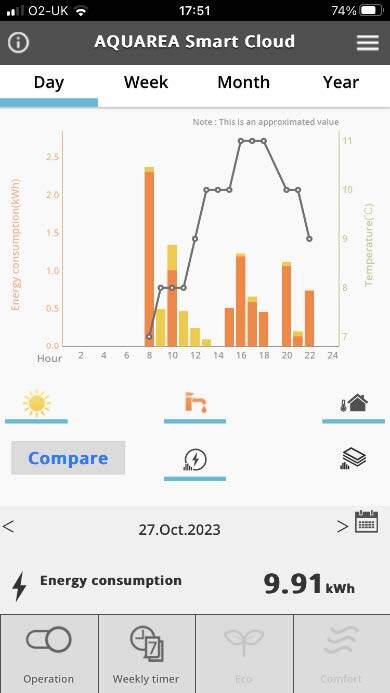
However, the learning curve has been steep and we have been lucky too. For once the weather has been helpful with some chilly and cold spells interspersed with milder ones as we moved from autumn into winter. This allowed us to take a managed approach to assessing how and when we should change the settings and assess their impact.
Apart from installing the ASHP and removing the Gas supply for hot water and heating in July, the first major step was to hook up to the online management system. This in turn had to be integrated with our Solar Edge electricity management system and took place in late October.
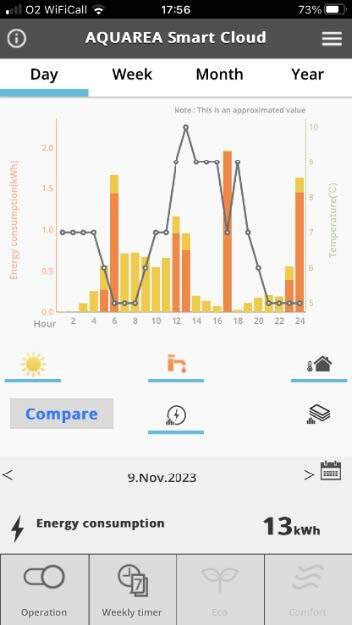
The second step followed soon after. We quickly realised we were only receiving intermittent ASHP data. We investigated and found we had not wired the ASHP to a continuous power supply. It had been wired to the intermittent supply which is activated when Centre users are in the building. We therefore connected it to the continuous power supply. This led to a significant increase in Community Centre room temperatures just in time for one of our chilly spells. As this was early November, we decided not to change any of the temperature settings and operating systems except for allowing the ASHP to operate ‘on demand’ from the Community Centre Main Hall heating control thermostat.
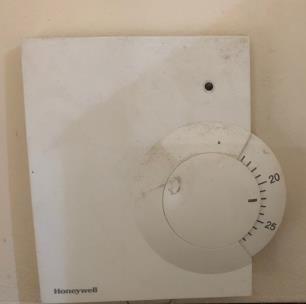
The third step was to understand the differences between various temperature recording devices. These are the Main Hall master heating control which drives the heating demand system; the standalone Main Hall thermometer, which records Hall temperatures 3 times daily, the 3 room Smart Meters and the ASHP external temperature and demand data recorder.
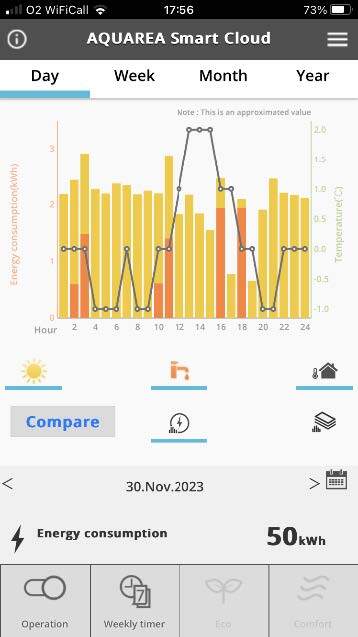
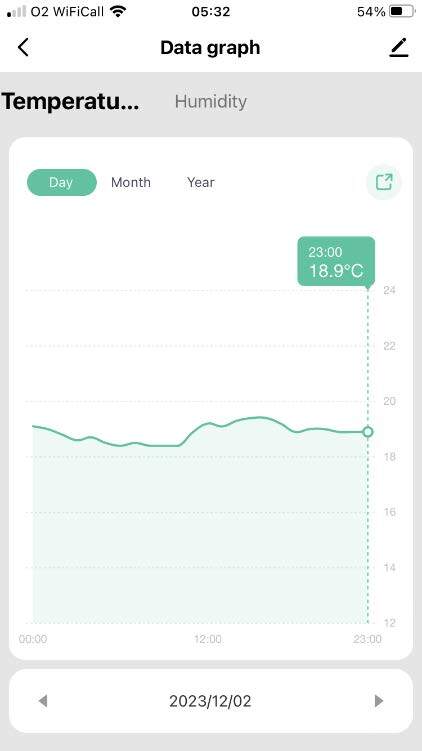
We found that the Smart Meters recorded a temperature which is about 0.8C below the standalone Main Hall thermostat. They also showed that room temperatures only achieved the room control ‘set point’ when lots of people were occupying each room and therefore emitting heat. However, the ASHP was ‘switching off’ – it was assuming it had achieved the required ‘set point’.
We concluded that the room set point controller was a very approximate temperature manager and the actual temperature was about 3 – 4 degrees less. After 2 weeks we increased the set point from 19C to 21C. Fortunately, this was just in time for the very cold early December snap – when the system recorded an external temperature of minus 7C.
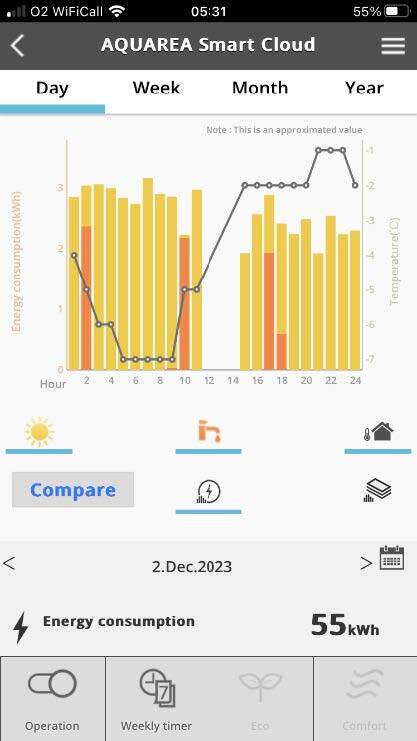
We are pleased to say that the system responded and met the higher set point in much more demanding circumstances.
Despite everything, the ultimate judges of ‘does it work’ are our Centre users, who vary greatly, from Mums and Tots groups to exercise groups, both gentle and vigorous to other more sedentary groups like the Library and Council meetings. We have constantly monitored their feedback and recently taken the decision to increase the temperature by another 1degree C
The outcome, as expected, is we have seen the daily temperatures lift in each room and electricity consumption increase as well. However, by far the biggest influence on power consumed is the outside temperature.
The Elephant in the room question: What does it cost to run the new system compared to gas heating?
Let’s return to our school report. ‘After one term, ‘Pano’ appears to be at least as good as the gas – measured in terms of how many kWh of electricity is consumed – compared to cubic meter of gas (1 m³gas = approx. 10.55 kWh electricity). We won’t be able to make a full assessment, taking into account all factors until the full year’s examination’.
We are gathering lots of information, to support our anecdotal and data driven learning which we will share in later updates and on our website.
What we must emphasise is that our results are entirely based on our Community Centre and they reflect the heating and insulation systems we have in place.
With so much going on around world let alone in the UK, which bit of the news did you listen to or miss in the past few weeks or months and can you recall everything?
By way of a little reminder, you may have missed the item that recorded its now 7 years since Kellingley Collierey closed (I recall it being opened!) and over the past few years Ferrybridge and Eggborough Power stations have ceased coal fired operations. The Selby Coalfield (which I also recall being developed) ended production 20 years ago in 2004. If you add in Drax power station, still a major electricity producer, you realise that Monk Fryston, Hillam and other local villages are at the heart of the UK’s electricity generation industry… so what’s happening now is the development of a new breed of 21st century generators.
In past updates we have reported on the upgrading of the Rawfield (Monk Fryston) substation by the National Grid as a key part of the Yorkshire Green National Infrastructure Plan. In this update we report a recent announcement made by Scottish and Southern Electricity (SSE) of the development of the Country’s largest Battery Storage Farm alongside this substation.
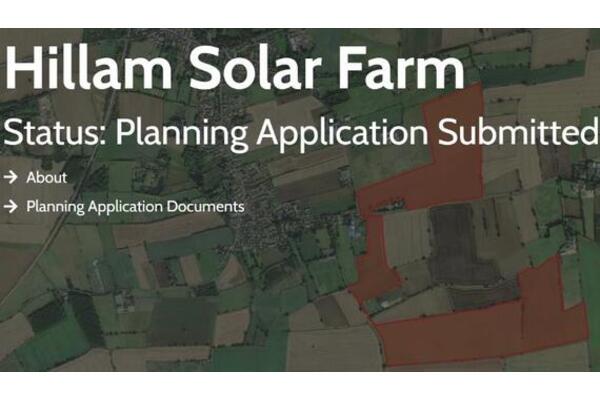
In Hillam, following a public consultation, Noventum Power have applied for planning permission to develop a 49.5 MWh Solar Farm to the east and south of the village. North Yorkshire Council (NYC) are just about to open their public consultation. You can find out more about the development at Hillam Solar Farm - Noventum Power and make any comments to NYC once the planning notices are posted. It is likely the planning application consultation will take place during January.
There are many more 21st Century power generation projects taking place locally taking advantage of the grid connection points at the former pit and power station sites. To date we aware of several local solar farm sites both in operation and under consideration. In our next edition we will try to list what we are aware of, and the range of generation and storage activities could well make us ‘the Silicon Valley of 21st power generation’.
Over the 4 years our project has been running, there has been a steady increase in the number of other organisations wanting to get started on making their premises energy sustainable. We are delighted to report that it is now recognised that energy efficiency is the most valuable step to make on that journey. Knowing where and how to start is key – and help is at hand.
The government has now made £20m available to assist with Energy Assessments as well as funding for capital costs to improve the energy efficiency of their buildings, reduce running cost and help to lower carbon emissions. The new Energy Efficiency Funding which starts in January 2024 and will be available from Groundwork. Please see this link www.vcseenergyefficiencyscheme.org.uk
North Yorkshire Council has also launched a fund to address climate change and welcome organisations to apply at https://www.northyorks.gov.uk/community-and-volunteering/grants-and-funding/uk-shared-prosperity-fund/community-climate-action-grants-programme-specification
We will be back in the New Year with more updates and news from all our partners.
With our best wishes for Christmas and the New Year
Thank you for your support - the Steering Group and the Project Partners
Monk Fryston and Hillam Community Association. St Wilfrid’s Church and Church Hall
Hillam Cricket and Football Clubs. Monk Fryston Primary School
The Community Centre website now has a section dedicated to the project, our embryonic Sustainability Information and Energy Advice Centre – where you can find the Interim and Final Feasibility study reports by Locogen and the Community Survey Monk Fryston and Hillam Community Association - Sustainable Buildings Project (mfhcc.com) and other project updates Monk Fryston and Hillam Community Association - Latest News (mfhcc.com) If you have any feedback or comments to share or require further information, please contact Ray Newton on 01977 682084 or 07706 795334 or via Monk Fryston and Hillam Community Association - Contact Us (mfhcc.com)
