Summer 2023 - Making it Happen
Sustainability Project Update #16

It is 4 years since our Community Building leaders started to consider what we could do provide hope for our village youngsters to combat growing concern about the impact of climate change and the need to develop sustainable buildings and a sustainable way of life.
This summer, as you will read, the building partners have taken more actions to make the project happen – and although some things appear to be negative - as everyone knows as well as providing hope our project is a learning and education process – so as one door closes another one opens – we have to find new ways of doing what we want to do.
A big hall is at the heart of any school and Monk Fryston school is no exception. It is used for many aspects of school life – assemblies, music, exercise, school lunches, PTA fund raisers, and by Community groups for meetings and keeping fit. Everyone is now going to be warmer or perhaps to be more precise ‘more comfortable’,
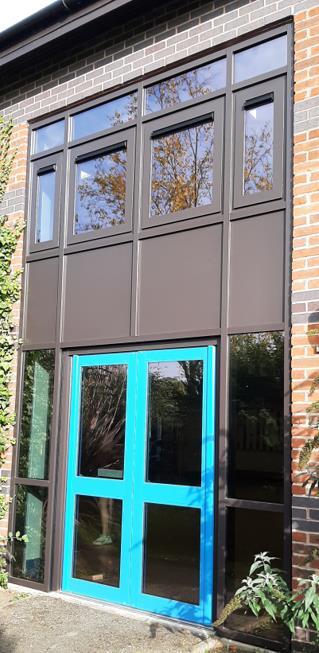
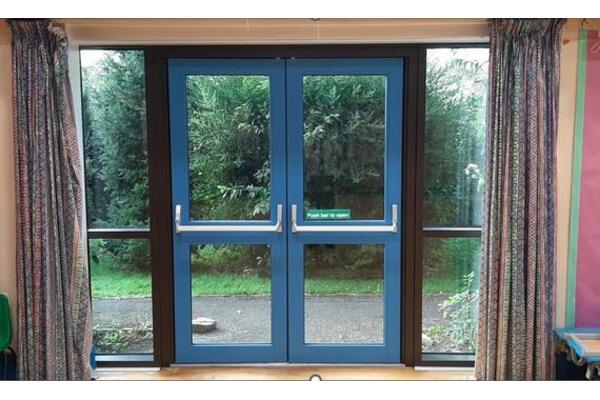
Headteacher Rick Weights reports ‘We replaced all the windows and doors in the hall over the summer with new energy efficient units that have a higher thermal efficiency rating. No more draughty doors! It's a lot better.’
Replacing the doors and windows was identified as an area for improvement by the school Eco Warrior team about 18 months ago when they conducted an energy survey of the school using the Community Thermal Imaging camera. Well done to everyone involved within the school community to ‘make it happen’ after identifying the problem and an opportunity to save energy.
A new school year means a new Eco Warrior team has been appointed and they have chosen the following topics to focus on in the coming year: reducing/ collecting litter (in school and the community): transport (encouraging walking & cycling): biodiversity (providing new habitats and homes). It’s easy to see how these topics can work and with support positively impact on all our community. We encourage everyone to support this year’s Eco Warrior team and ensure the school’s very impressive Eco Schools record continues.
Breaking News: Rick also reports ‘I have just been notified that we have an energy efficiency grant from the government and we are able to spend this on solar panels, so we have an array being installed at the end of October in half term. This will go on the hall roof (south facing aspect with large roof area) and very much matches the feasibility study that Locogen provided to the project (with a grant from the Rural Communities Energy Fund). I don't think funding can stretch to a battery at this point but the plan will be able to accommodate this when we can.’
This is fantastic news for the school and the project – another step towards our aim of making our buildings Carbon neutral. Well Done.
Our project never ceases to produce situations which we are humble enough to report and say – maybe this reflects what you are and are not doing at home? - please take note and check.
One such case was when we discovered that we had left the Immersion Heater switched on for about 8 years because we didn’t know until we examined the real time energy data that it was running on constant. By switching it off the Community Association have saved around 5kWh (or 25%) of electricity a day.
St Wilfrid’s has just reported another, possibly widespread, situation. That is not using the available boiler heating controls already installed and are not using at all or not using to their optimum. Like everything else the origin of this discovery is the need to reduce energy consumption and take a closer look at the detail.
Earlier this year, the Church had three boilers. Two in the church hall and a big, difficult to manage boiler for the Church. At the time all the boilers required regular manual intervention to switch on, change settings and reset them when circumstances changed, which in the case of the multi user Church Hall could be by users fiddling with the settings. In late spring, the old Church Hall gas boiler ‘gave up’ and a new more energy efficient gas boiler was bought to replace the two boilers in the hall. It came with a wifi enabled programmable controller, which was activated. Following a successful trial period, the Church building managers considered having a similar controller to automate the Church Boiler. A boiler engineer was called in and it transpired a standalone wifi programmable controller was waiting to be commissioned… and had been there for a number of years!
To cut a long story short, the Church boiler now has bespoke settings to ensure that furnishings and other church materials are protected and the building is warm for services despite operating for shorter periods and all controlled remotely off site by a member of the Parochial Church Council.
Now that’s a win, win driven by the need to save energy, save money and with the bonus of less effort.
I wonder how many households are ignoring what they might do – to make similar savings?
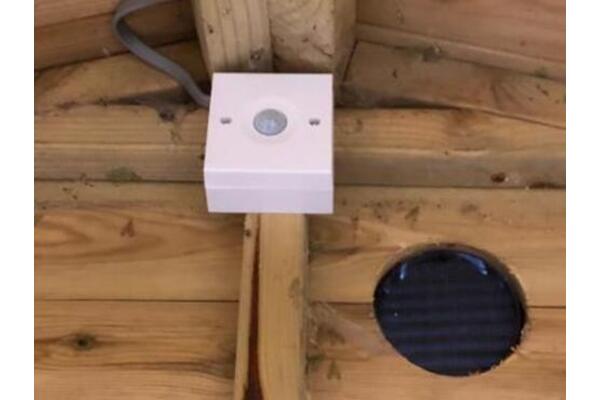
One of six PIR’s movement sensors fitted at the Community Centre See The Story below
If you think being the prime minister and running the country is difficult you should try to find a workable long term, sustainable solution to improve how to dispose of the clubs’ waste water. The story goes on.
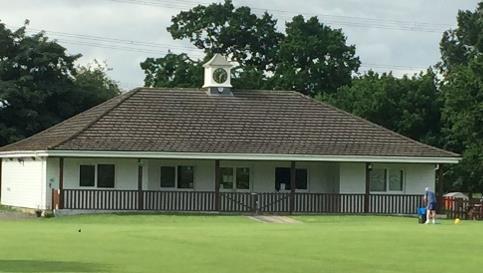
The requirement is to find an acceptable way of replacing the Sports Clubs Cess Pit which is susceptible to ground water ingress and requires a tanker every month to remove the waste and ground water collected. Initially it was thought a Biodigester would be the solution until it was realised that with many organisations using the club the ability to manage and control the effluent was limited and therefore there was a high risk of mismanagement and overwhelming the existing system. In addition, as both clubs are volunteer led and operated it was essential that the replacement project and investment would require 20+ year management commitment – which none of the current volunteers could commit to.
The next step was to look at a long-distance pipeline to the nearest mains drain and whilst this would require a pumped rising main, after some initial doubts an acceptable solution seemed to have been found… only to be turned down for technical reasons by Yorkshire Water. So, for anyone wishing to find an alternative to a Cess Pit we have acquired a lot of learning which we can share. Who would have thought that at the start of the Sustainability Project?
For both clubs, the search for a solution continues; one door closes and we are sure another one will open.
Meanwhile the Cricket Club is considering enhancing the pavilion, which is used through the week as the village nursery, by adding a lobby to the entrance to act as an air lock and energy saving measure on this very well insulated building.
In update 15 we shared the news of the installation of an Air Source Heat Pump at the Community Centre to replace our gas heating system. We still have to finish off this installation by adding a few whistles and bells plus a 2nd 10Kwh battery. During the summer we have undertaken most of our energy efficiency projects. Like the school a new more energy efficient Fire Door, and a lot of energy efficiency lighting upgrades with movement sensors linked to low energy lighting.
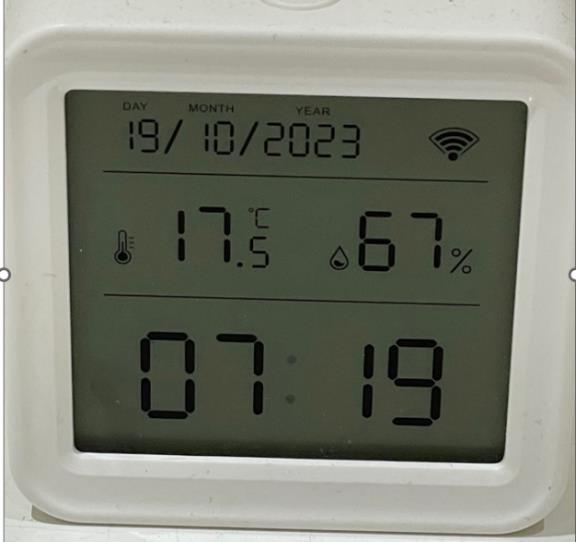
To date the ASHP has worked well. We have not adjusted any of the heating run time control settings so we can obtain a comparison of performance date between last year and this. However, the recent ‘3 seasons in a week weather’ over the last two weeks has provided us with an excellent snapshot of what we might need to do to make the ASHP work for us all year around.
One thing we have invested in this year are 3 smart life Wifi temperature recorders. These provide excellent daily and monthly data and are already indicating and confirming what we instinctively know, rooms are colder after heating has been off overnight, rooms with a lot of windows are colder still and well insulated rooms perform best.
The daily, averaged, month to date data, for the first half of October when the ambient temperatures varied from a unseasonably, balmy, mid 20’s down to a very chilly overnight frost of several days shows up very well.
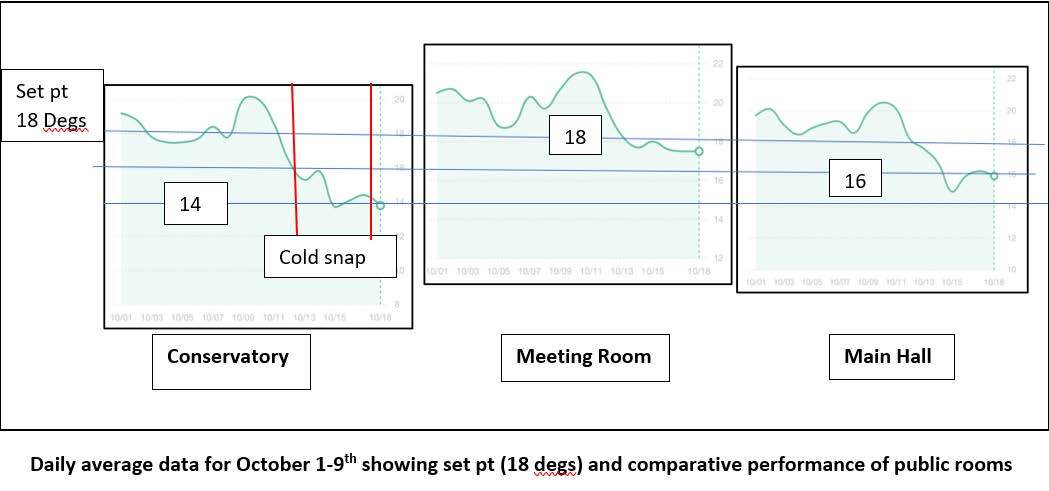
Fortunately, the ASHP was able to recover the room temperatures to our normal set point of 18 degrees quite quickly each day however this is not reflected in average daily data because the overnight room temperatures have continued to drop quite quickly. Our intention now is adjusting the run times whilst undertaking some further energy efficiency measures. We have yet to undertake the comparative assessment of energy consumed with gas heating to the electricity powered ASHP.
Finally, we have reported before about the performance of our Solar PV installation and have commented that the month-by-month generation profile is very near to the one forecast by our installation contractor. This is continuing to be the case but with the odd difference; if you can remember sunny June, we generated over 1mWh and beat the previous high by just 1kWh whilst October is looking pretty poor at the moment.
Perhaps the news needs balancing; we have been told that the Government is back peddling on its commitment to sustainability, that the recent North Sea wind farm auction didn’t receive any bids and that we need a massive investment in the National Grid, car chargers etc. All of this is true.
However, we also know, as it affects our community, that plans are well advanced to upgrade the National Grid. The Government also announced that boiler scrappage grants have been increased from £5,000 to £7,500 to help develop the renewable heating industry.
There has been a major technical breakthrough in solar panel output. When it is available in about 5 years’ time the new panels will be able to generate almost double the electricity currently produced.
Hillam now faces the prospect of a proposed solar farm on the eastern edge of the village. When questioned at the Public Consultation event, the project manager commented that if the proposal went ahead - he felt it would be equipped with the new higher output solar panels and that this technical breakthrough could be the reason why the wind farm auction fell flat as this breakthrough could have a game changing impact on future energy costs.
These observations provide a balance to our bad news orientated press and good reasons for hope in achieving an affordable, sustainable future. Whilst there is always scope to do more, many substantial infrastructure investments are in the pipeline along with other embryonic sustainability related innovations.
Thank you for your support - the Steering Group and the Project Partners
Monk Fryston and Hillam Community Association. St Wilfrid’s Church and Church Hall
Hillam Cricket and Football Clubs. Monk Fryston Primary School
The Community Centre website now has a section dedicated to the project, our embryonic Sustainability Information and Energy Advice Centre – where you can find the Interim and Final Feasibility study reports by Locogen and the Community Survey Monk Fryston and Hillam Community Association - Sustainable Buildings Project (mfhcc.com) and other project updates Monk Fryston and Hillam Community Association - Latest News (mfhcc.com) If you have any feedback or comments to share or require further information, please contact Ray Newton on 01977 682084 or 07706 795334 or via Monk Fryston and Hillam Community Association - Contact Us (mfhcc.com)
