2024 Making Sustainability Sustainable
Sustainability Project Update #18


This is our first project update in 2024 so I hope you, our readers and supporters, haven’t forgotten about us. We have continued the work of the Sustainability Project and as you will read a lot has happened albeit perhaps on a longer timescale. It is now time to embed and build on what has been achieved over the past 4 years.
By way of a general update, the first thing to note is that the Lottery Fund extended our Community Fund grant and project by a year so it will now end in December 2024. In part this was because we had not completed all the capital elements of the project at the Community Centre. These are now nearing completion.
The School is continuing to make great progress and embed its Eco Schools work with the children.
The Cricket Club, on behalf of themselves and the Football Club have suffered frustrations to their sustainability ambitions but are close to taking a major step forward.
The Community Centre achieved Carbon Neutrality for a four- month period this summer and continues to share its learning with other community organisations, who are now starting to put ideas into action with the help of sustainability grants.
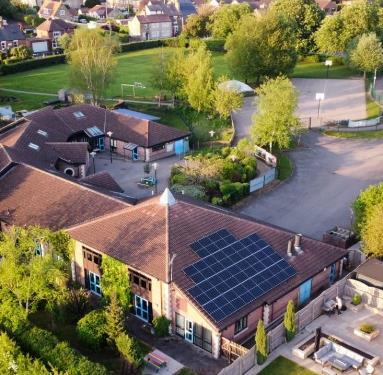
In Autumn last year, the school successfully obtained a grant to install 60 solar panels which have a maximum generating capacity of approximately 20kWh per hour. This is around 250% (two and a half times) more than the Community Centre generates. Based on that performance, the school could generate 20mWh of electricity pa. The solar panels will help power the ground source heat pump installed in 2021 as well as all their other electrical equipment. The school is now benefitting from previous energy efficiency work undertaken such as installing a new heating system control program, replacing existing lights with LED lights, replacing old leaky double glazing with new units and fitting new thermal screens (in the form of thermal curtains) to external doorways to stop draughts and minimize heat loss when the doors have to be open for security purposes at playtimes.
The school has continued to reinforce and deepen its commitment to integrating Sustainability into all aspects of school life and the curriculum. This culminated in the attainment for the 4th successive year of the Eco Schools Green Flag award - this year with Distinction. The whole school deserves our wholehearted congratulations for this well-earned achievement. I cannot do justice to the very positive comments made by the Eco Schools Inspector in the feedback report to Headteacher Rick Weights, so it is added to the end of this update. Well done Rick and the whole MF School community.
As we continue to learn from our project activities, we share this information in both formal and informal ways.
An on-line presentation was made to Tees Valley Rural Action in Spring 2024 titled Energy Sustainability: Getting started and saving money in Community Buildings.
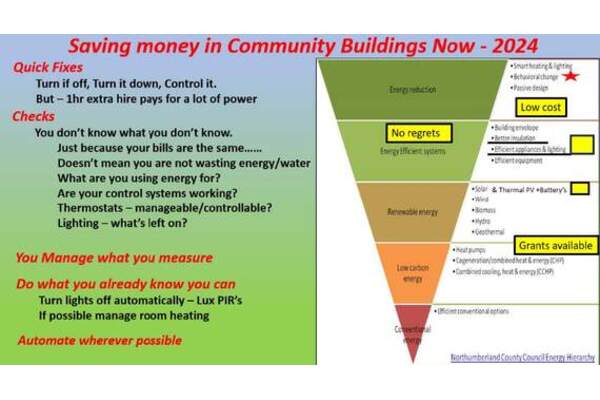
Later in May, a different presentation was made locally at Brayton as part of a Community Climate Ambassadors course. This was titled Benefits of Community Action - Monk Fryston and Hillam Community Centre’s Journey towards Carbon Neutrality.
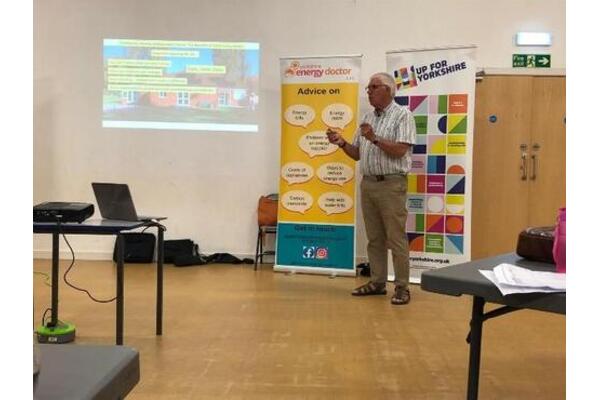
Both these presentations were recorded, as was the presentation to the Ryedale Environmental Group in November 2023.
Unfortunately, we were not able to fulfil an invitation to speak at the East Riding Village Halls AGM, but we plan to share our continued learning and reflections with them in the future.
The Ryedale and Tees Valleys presentations are available to view on-line; details are below and the Community Ambassadors course presentation will be available at the end of their program being held across North Yorkshire.
Another aspect of sharing information is through our participation with the North East and Yorkshire Net Zero Hub Community Energy Strategy Group which helps groups to get started on the nation’s bid to Net Zero. See the presentations and much more at https://www.neynetzerohub.com/wp-content/uploads/2024/05/Community-Energy-Group-Resources-Library.pdf
More locally, we have been delighted to help Sherburn Old Girls School by hosting a visit and lending them our Thermal Imaging Camera (TIC) to do a Thermal Imaging survey of their building. Tees Valley Rural Action also borrowed the TIC and they are now acquiring one for their members.
We also helped Sherburn White Rose Sports Club and afterwards were glad to hear they had secured grants from the NY Shared Prosperity Fund and Awards for All to purchase solar panels, batteries and noise attenuation panels as part of their sustainability project at their Club House Centre.
Sustainability come in many different forms and again it was encouraging to hear that another organisation we helped; Barlby Parish Library and Community Hub had made an excellent start by installing lux – PIR’s in their library which has excellent natural light, to automatically reduce the time that lights need to be on. Another step was to give all their volunteer staff body warmers to wear and avoid the easy fix of turning up the thermostat dial. This move is similar to supermarkets who provide body warmers to staff where temperatures range dramatically as you move from cold to ambient aisles.
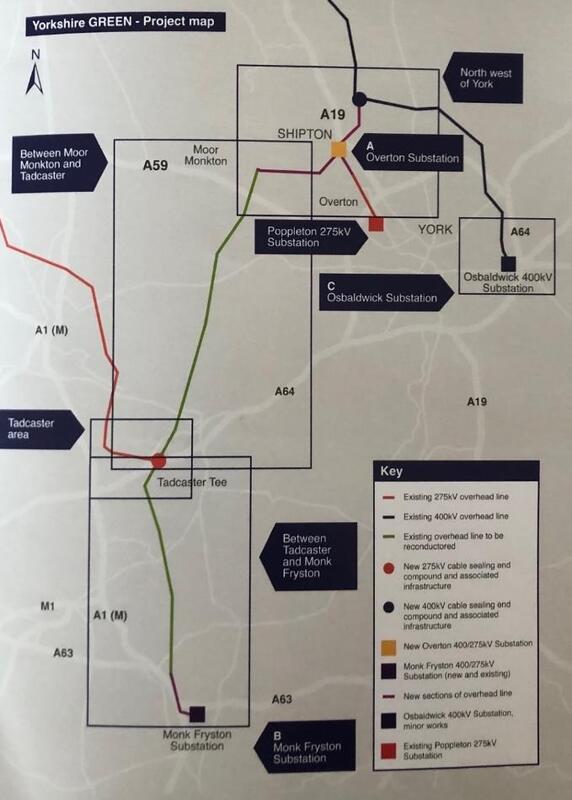
In the last project update no 17, I suggested that Monk Fryston and Hillam might become the ‘Silicon Valley’ of the renewable energy industry as part of the country’s move to Net Zero. Since then, things have moved forward at quite a pace. Within the past month Ofgem announced that it had approved the National Grid proposal to spend £3.4bn to create an energy superhighway from Peterhead in Scotland to nearby Drax where it will link into the existing grid; other links will also be built from Scotland and the North Sea to be funnelled into the Yorkshire grid.
Ofgem also announced that £300m had been approved to upgrade the Yorkshire grid. This is to be called the <span style="background-color: #ffff00;">Yorkshire Green Project</span> and the Monk Fryston sub-station on Rawfield Lane is a key part of it. Approximately £100m will be spent to enlarge the facility over the next 3-4 years and work will be starting in the next few months.
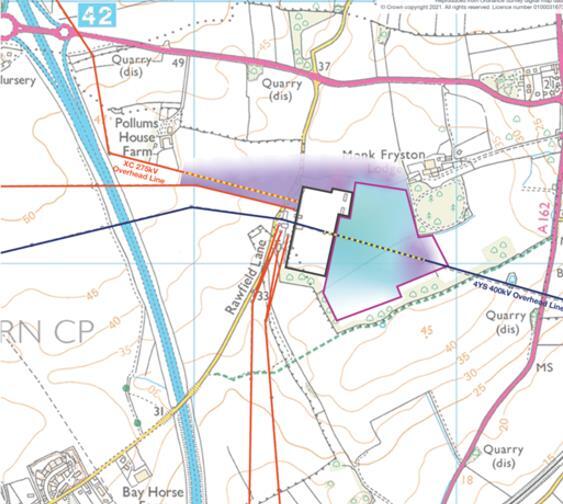
Separately, but in parallel, earlier this year in March, Scottish and Southern Energy (SSE) obtained planning permission from the Government to build the country’s largest electrical storage battery farm alongside the enlarged substation. This is a long-term development with planning permission for 40 years. SSE have already made contact with the Sustainability Project and have expressed a desire to be good neighbours. Indeed, they are already talking to the Cricket Club about how they can help them and by implication as the club provides all the utilities to the Football Club, the Football Club will achieve their sustainability goals. Hopefully, this will be some consolation to both clubs for the many frustrations they have suffered whilst trying to solve their long-term waste water disposal problem.
I am sure we will hear much more about these two projects along with the potential Hillam Solar farm and perhaps similar ones in the future, but for now, recent announcements are that more wind farms have been approved and successfully auctioned by the Government.
Our villages are certainly in the early vanguard of the push towards the country’s Net Zero Goals.
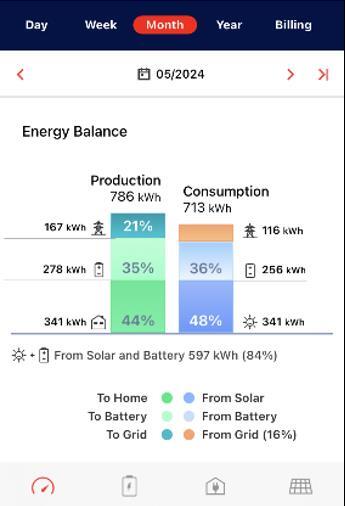
May 2024 proved to be the month when the Community Association achieved its aim of not emitting any CO2 and being self-sufficient as our energy generation was greater than our consumption. You can see the summary of the monthly stats – we generated 786kWh and consumed 713kWh.
Due to the poor weather we have suffered all year it was a close-run thing. Our solar output is about 20% down on recent years. Frequent slate grey skies have not helped. What has helped is the work we have done over the past year by installing a second 10 kWh battery and a number of energy efficiency tweaks such as lux sensitive PIR’s to maximise natural daylight and by adding more insulation where required.
Eagle-eyed readers will soon spot that even though we were carbon neutral and generated more power than we consumed we still needed 16% of our power to be supplied by the grid despite having 2 batteries. Quite frankly the batteries are very important (36%) but we always need help from the grid when we start up large motors such as our oven and not surprisingly the weather doesn’t follow our demand/consumption timetable.
The Good News is that for the past 4 months we have continued to be better than carbon neutral, but with shortening days and temperatures dropping as we move into autumn, we will soon start consuming more electricity than we generate again. Hence the importance, as a nation, to develop enough renewable energy and energy storage to meet our demand with flexibility, when the sun doesn’t shine and the wind doesn’t blow, so it’s available when we need it.
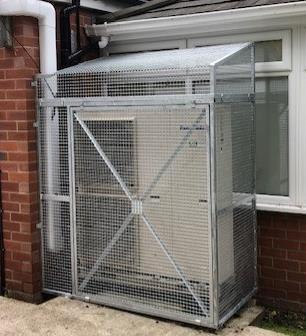
The answer is – very well. After some initial teething problems reported in our last update no 17 the ASHP operated through the winter, spring and summer and met all our needs.
Our assessment is that after 1 year it has delivered more heat to our building than was delivered from the gas heating system; this is because we leave the system on 24/7/365. The gas system was managed to switch off through the night and come on early morning to warm the centre – which was fine except when there was a cold snap and it was chilly first thing (7am) just as the first users were arriving.
The question which everyone asks – what about the costs? Does it save you money or cost you more?
The answer is we believe costs are about the same given the variability of the weather. This is based on our comparison of gas consumed (used only for heating and hot water) to the electricity used for the ASHP heating. Using a coefficient of 1:3 for the ASHP. That is 1 unit (kWh) of electricity consumed for every 3 units (kWh) of heat generated and transferred to water heat. As electricity costs about 3 times more than gas – broadly the cost is the same.
But – even if all the units of electricity came from a fossil fuel source, which they don’t, we would have generated only one third of the CO2 we previously did burning gas at the Community Centre. That is important. Below is more detailed information about the ASHP performance and its impact on the Community Centre heating.
Thank you for your support - the Steering Group and the Project Partners
Monk Fryston and Hillam Community Association. St Wilfrid’s Church and Church Hall
Hillam Cricket and Football Clubs. Monk Fryston Primary School
More information can be found on the Community Centre website including Interim and Final Feasibility Studies, the Community Survey and all our Project Updates.
https://www.mfhcc.com/sustainability-project/latest-news/project-updates/
If you have any feedback or comments to share or require further information, please contact Ray Newton on 01977 682084 or 07706 795334 or via Monk Fryston and Hillam Community Association - Contact Us (mfhcc.com)
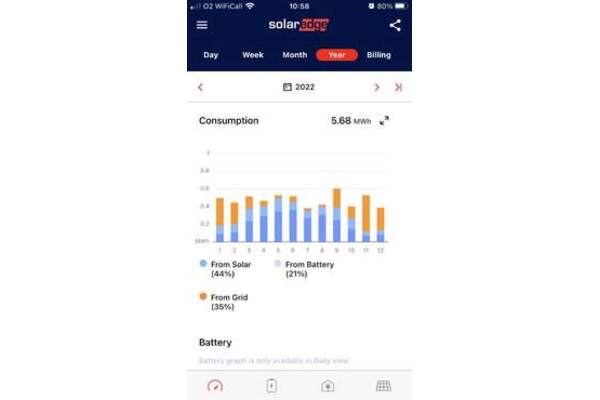
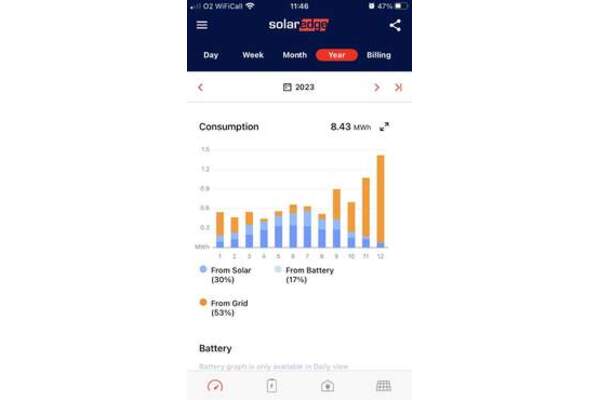
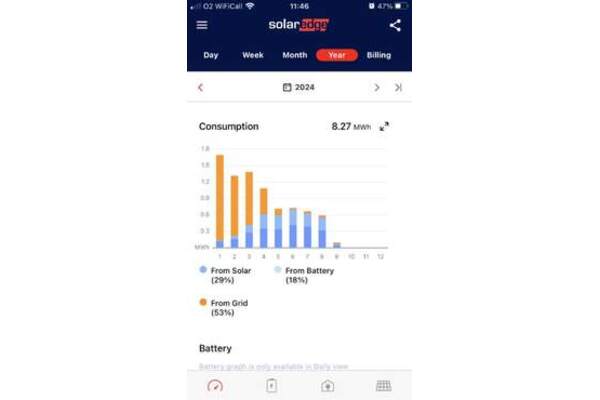
The graphs show the total amount (all needs incl. lighting etc) of electricity consumed (Gold bars) in 2022, 2023 and 2024 by month and the amount generated at the Community Centre (in Blue) from the Solar Panels. We removed the gas boiler and installed the ASHP in July 2023. It became fully operational in November 2023.
Please note: The Community Centre was energy self-sufficient from May to Aug 2024.
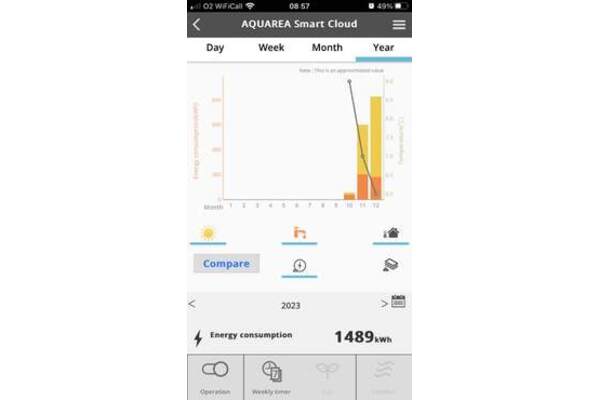
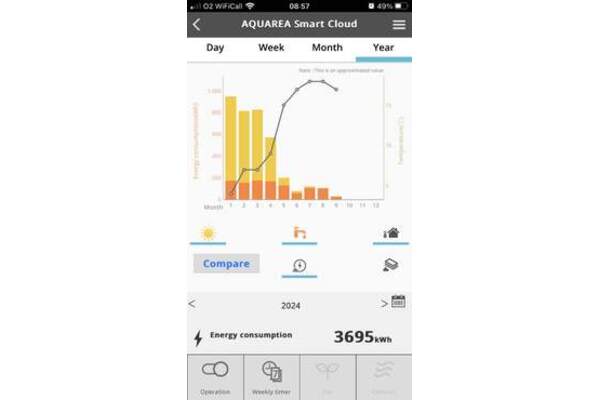
This bar graph and other data data is transmitted by wifi 24/7/365 from the ASHP. The orange blocks represent the consumption of electricity for our hot water, whilst the yellow blocks reflect the demand to meet the Community Centre ambient temperature set points of 19 degrees.
Not surprisingly, this demand follows the external ambient temperature line (this is a monthly 24/7 average reflecting the position of the thermometer).
The ASHP does not react independently to the external temperature but is only triggered by demand for either hot water or more internal heating.
We have two areas which we hire to users.
The smaller Meeting Room is a space mainly for sitting and talking (the What the Dickens Library, Local History Group and committee meetings); its lowest average temperature of 19 deg C in January after the Christmas close down for decoration. From Feb 2024 the minimum ave temp has been 20 deg C.
The Main Hall which is used from 7am until 9pm for active groups, parties etc. Its lowest average temperature of 18.6 degrees C in January after the Christmas close down for decoration. From February the lowest average temperature is 18.6, and around our 2024 set point of 19 degrees or above for most of the year. In 2023 our set point was 17 degrees when we heated the Hall by gas.
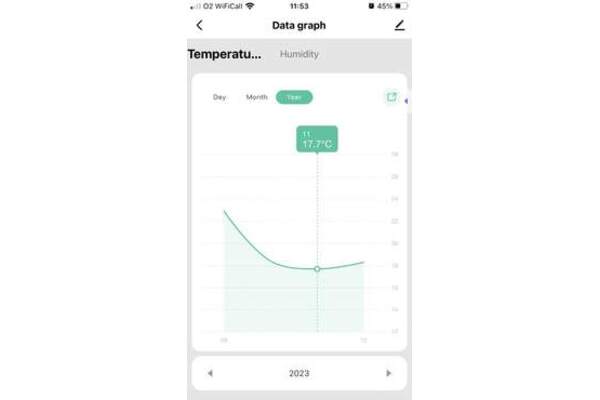
Meeting Room A
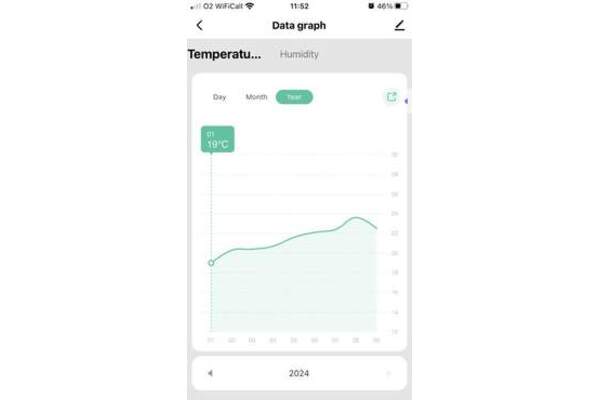
Meeting Room B
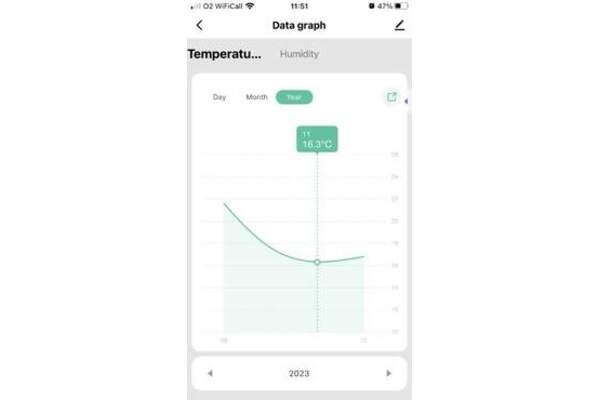
Main Hall A
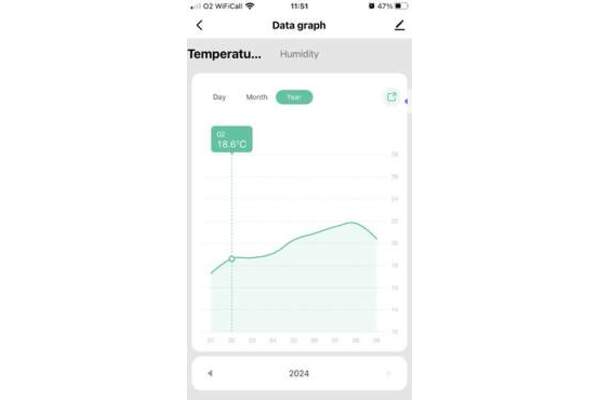
Main Hall B
Congratulations!!! Fantastic work Rick!
We are very pleased to tell you that you and your Eco-Committee at Monk Fryston Church of England Voluntary Controlled Primary School have been successful in meeting the requirements for the Eco-Schools Green Flag Award.
We reviewed your application and noted the following:
It's wonderful that you have appointed such a representative Eco-Committee, this shows your school’s excellent commitment to both the programme and the eco-cause. It’s great to see that you had such a group of eager, enthusiastic volunteers. It was also wonderful to see that they were supported by a member of staff. We love that you kept minutes from your meetings and that they helped to track, guide and prompt your activity, and thank you for including the excellent example.
It was wonderful to see how completing your Environmental Review helped to raise the level of awareness in your school and helped your Eco-Committee to identify the issues and spot gaps in your school's existing environmental activity. It was also brilliant to read that the Environmental Review helped your pupils appreciate everything that your school is already doing to benefit our environment and identify areas to work on in the future. Your Action Plan shows that your Eco-Committee have carefully considered how they can involve their entire school in their planned Eco-Schools’ activities to achieve maximum impacts and raise awareness amongst their school community.
We love the range of activities that you and your Eco-Committee planned for delivery. The fact that they cover a wide range of outdoor activities (community litter-pick, Big Walk & Wheel, a ‘no idling’ vehicle policy, new outdoor bins, animal homes and feeders, and refurbishing your pond) is excellent.
It was also great to see accountability and a monitoring scheme clearly marked in your Action Plan, although we were surprised there was no Evaluation system in place. Great work though!
Your Curriculum Link examples are imaginative, practical and fun, making environmental education accessible and engaging, well done! We’re really impressed at how you’ve linked environmental issues to a variety of curriculum areas. We loved seeing the lovely examples of your pupil’s work and the photos of them enjoying their activities. This is a great example of layering in sustainability and climate change into your studies. We loved reading about how you had incorporated learning about global issues not simply into the Geography and Science Curriculum (most common ones) in your school, but also into other areas such as English and Art. Great work!
Your Eco-Board is great. Your board is incredibly visual and engaging and promotes your work in a very attractive way. It’s also good to see your Eco-Committee members on the board. This is a great way to raise their esteem and make their schoolmates feel like they can approach them and get involved with your Eco-Schools work! We love how active your Eco-Committee was in communicating their activities school-wide with both assembly and class feedback and use of the school newsletter, website and social media as well as the Eco-board itself. These all combine to make a great approach! We love that your pupils have taken their great work beyond the school gates and into their local area with a wonderful community litter-pick, Big Walk & Wheel and your great Healthy Active Summer Challenge. We are certain that your pupils will have greatly benefitted from your involvement with such outside organisations as Sustrans and their community work.
We thought your Eco-Code was brilliant! It was punchy and really creative, setting out tangible and accessible calls to action your whole school can get behind! I hope you and your Eco-Committee take great pride in your achievements, when listed it's surprising how many there are – however, the improvements to your school environment with the lovely biodiversity measures and, most of all, your fantastic community work, especially the Big Walk & wheel and the traffic initiatives (we loved those) all nicely stand out!
Congratulations to everyone for the great work you have managed to do, earning your Green Flag with Distinction in style.
You should all be very proud of your work and the application you have submitted!
